Is Breathwork Dangerous?

Before we call breathwork dangerous, can we please understand breathing?
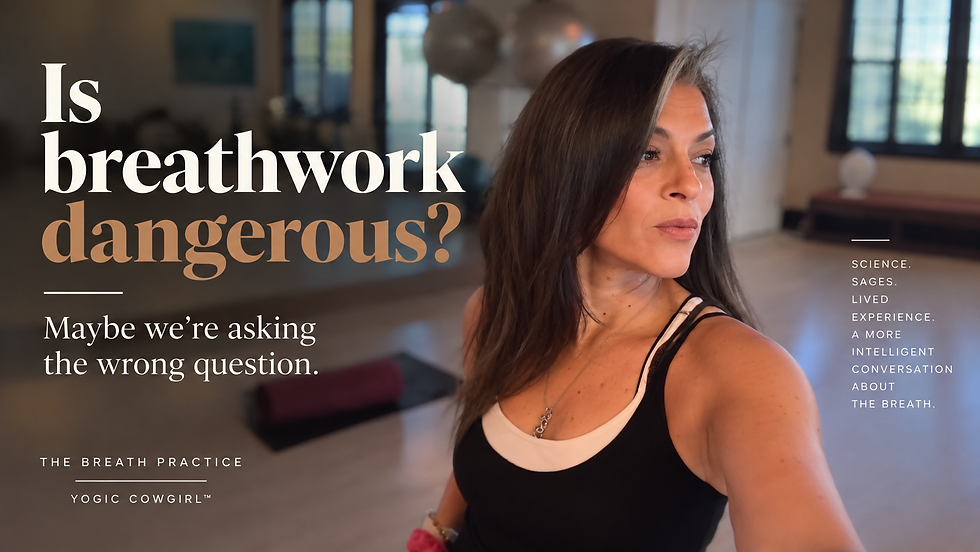
Maybe we're asking the wrong question.
By Christina Elena McHugh
Founder, Yogic Cowgirl™ | Nervous System Educator
Where the Ancient East Meets the Wild West™
There is a conversation happening around breathwork that I believe we need to have.
Not because breathwork needs defending.
And not because every breathing practice is appropriate for every body.
Some aren't.
Some techniques are powerful. Some require preparation. Some require careful screening. Some should not be practiced by certain people under certain circumstances. And yes, there are facilitators teaching practices they do not understand deeply enough.
We should talk about that.
But increasingly, I see something much broader being said:
Breathwork is hurting people.
Every time I encounter that sentence, another question comes to mind.
Which breathwork?
Slow breathing?
Rapid breathing?
Extended breath retention?
Prāṇāyāma?
Alternate-nostril breathing?
Breath of Fire?
Wim Hof-style breathing?
A five-minute exhale-focused practice before bed?
These aren't physiologically identical interventions.
Calling all of them simply breathwork and declaring the category dangerous tells us almost nothing about what actually happened.
But there is another question I think we should be asking first:
How was that person breathing before anyone taught them a breathing technique?
Because they didn't arrive without a breathing pattern.
None of us do.
You Were Already Practicing a Breath Pattern
Before yoga.
Before meditation.
Before somebody told you to breathe into your belly.
Before your first breathwork class.
You were breathing.
Automatically.
Quietly.
All day and all night.
And over a lifetime, your breathing has been there while you worked, slept, exercised, argued, laughed, cried, made love, concentrated, worried, grieved, felt threatened and felt safe.
We tend to think of breathing as an on/off biological process.
I'm breathing, therefore breathing is working.
But breathing is more interesting than that.
Respiratory medicine recognizes what are called dysfunctional breathing patterns or breathing-pattern disorders. Researchers have described patterns involving overbreathing, frequent sighing, upper-chest-dominant breathing and altered coordination between the chest and abdomen.[1]
That does not mean every unusual breath is dysfunctional.
Your breathing is supposed to change.
It should change when you run.
When you cry.
When you sleep.
When you're startled.
When you're excited.
When you're having sex.
When you're safe.
Breathing is adaptive.
The question that fascinates me is what happens when a pattern that once served the body becomes something we keep practicing long after the moment has passed.
What happens when you hold your breath every time you concentrate?
When you brace your abdomen every time you're stressed?
When your shoulders rise with every inhale?
When you're sitting perfectly still but breathing as though your body is preparing for something?
What happens when you've practiced that pattern not for an hour... but for years?
That is the conversation I want people to have.
Not:
What breathing exercise should I do?
But first:
How am I already breathing?
The danger isn't that people aren't breathing enough air. The problem can be that they have lost an efficient relationship with breathing altogether.

The Brown Paper Bag: The Image That Taught a Generation to Fear the Breath
For many people... particularly older adults... the word hyperventilation immediately brings up the same image.
Someone panicking.
Gasping.
A brown paper bag held over the mouth.
Movies and television repeated that scene for decades until the paper bag became almost shorthand for:
Panic. Loss of control. Something is wrong with the breath.
And I think some of that imagery stayed with us.
Now when people hear breathwork, especially rapid or intense breathing, that old association can come right back.
Don't do that. You'll hyperventilate.
But what actually happens during hyperventilation is much more interesting than the old movie scene.
Physiologically, hyperventilation means you're ventilating more than your body's metabolism requires.
When that happens, you can exhale carbon dioxide faster than your body is producing it.
CO₂ falls.
Blood chemistry temporarily shifts.
Blood vessels supplying the brain can constrict.
And you may experience very real sensations: tingling, lightheadedness, dizziness, feelings of breathlessness or altered awareness.[1]
Those sensations can then become frightening.
You feel something strange.
You think, Something is wrong. I need more air.
You breathe even more.
More CO₂ is lost.
The sensations intensify.
Now the body can become frightened by its own physiological response.
That feedback loop matters.
But here's what also matters:
The breath may not have started the alarm.
Fear, pain, exhaustion, an unfamiliar body sensation, conflict, overstimulation or a panic response may already have changed the way the person was breathing.
Once overbreathing begins, however, breathing can become part of what perpetuates the experience.
That's very different from saying:
Breathing is dangerous.
And About That Brown Paper Bag...
The paper bag wasn't complete nonsense.
There was physiology behind the idea.
Rebreathing exhaled air can raise inspired carbon dioxide, which was why paper-bag breathing was historically used when someone was assumed to be hyperventilating from anxiety.
The problem was the assumption.
Rapid breathing, chest discomfort and breathlessness can also occur during serious medical conditions. Rebreathing from a paper bag can reduce inspired oxygen and may delay recognition of a medical emergency. A published emergency-medicine report documented the hypoxic hazards of paper-bag rebreathing and argued against its routine use outside settings where oxygenation and other causes could be appropriately assessed.[2]
So yes.
Let's retire the paper bag.
But perhaps we can retire some of the fear that came with it too.
Because the lesson was never supposed to be:
Don't change your breathing or something terrible will happen.
The better lesson is:
Breathing changes physiology.
Which is exactly why understanding your breath matters.
Oxygen, CO₂ and Nitric Oxide | Without Making This Complicated
This is where I think breath education often gets lost in translation.
We start talking about chemistry and receptors and partial pressures and suddenly the average person checks out.
So let's keep this simple.
Oxygen helps support cellular energy.
Carbon dioxide helps regulate important aspects of respiratory chemistry and circulation.
Nitric oxide is a signaling molecule with many roles, including vascular regulation, and the nasal passages are part of that story.
And breathing influences this incredibly sophisticated system.
Which brings us back to something wonderfully simple:
Breathing isn't just about getting more air.
The Breath and Nervous System Have Been Talking Your Entire Life
Your breath changes with your state.
That's not bad.
That's brilliant.
A healthy nervous system isn't permanently calm, and I don't want yours to be.
We need activation.
We need sympathetic energy.
We need to run, respond, protect ourselves, compete, give birth, get excited and move through the world.
Regulation doesn't mean living forever in some blissful parasympathetic bubble.
Regulation is adaptability.
Can the body mobilize when something is happening?
And can it recover when that demand has passed?
The breath participates in that dance.
This is why I'm interested in your breathing pattern.
Not because I'm looking for something wrong with you.
I'm looking for what your body has learned.
Do you brace?
Do you hold?
Do you sigh?
Does your breath become shallow when you're concentrating?
Does it become fast when you're worried?
Does your belly soften when you feel safe?
What happens when somebody simply asks you to notice your breathing?
There's information there.
And noticing it does not require fear.
It requires curiosity.
Long Before “Breathwork,” There Was Prāṇāyāma
This is where the yogi in me enters the conversation.
Long before breathwork became an industry, yogic traditions were exploring the relationship among breath, body, mind, attention and consciousness.
They called practices of breath regulation prāṇāyāma.
Prāṇa is a traditional yogic concept.
It is not simply another word for oxygen.
I think we diminish yoga when we try to make every ancient teaching sound scientific.
And I think we diminish human knowledge when we assume something has nothing to teach us unless PubMed has already studied it.
It means there are different ways human beings have investigated their experience.
The Haṭha Yoga Pradīpikā, for example, doesn't treat powerful breathing practices casually. Its chapter on prāṇāyāma begins with practice under the guidance of a teacher and later emphasizes gradual development. It famously compares working with the breath to gradually bringing powerful animals such as lions, elephants and tigers under control.[4]
I love that imagery.
Because the message isn't: Be afraid of your breath.
The message is: Respect the practice.
The Yogis Weren't Collecting Breathing Hacks
There is another teaching passed down to me through my yogic education that matters deeply here.
Depth.
I was taught that practitioners might work with on practice for years... even decades.
Sometimes a student might be given one kriya to master.
I am not presenting that as a universal historical claim about every yogi or every lineage.
I'm telling you what was transmitted through the teaching I received.
And I think oral lineage deserves a place in this conversation too.
Imagine the difference.
Today we can learn seven breathing techniques before lunch.
The yogic model I was taught asked something different:
Do you know the practice?
Have you returned to it?
Observed it?
Practiced it when you're tired?
Angry?
Grieving?
Distracted?
Peaceful?
What happens after a hundred repetitions?
A thousand?
What does your teacher see that you cannot yet see yourself?
Knowing the instructions isn't the same thing as knowing the practice.
And a kriya practiced for years under guidance is not necessarily the same intervention as a technique learned on Saturday and facilitated for strangers on Sunday.
That's not me being precious about yoga.
That's me asking us to respect depth, context and responsibility.
Perhaps these practices aren't too old for the modern nervous system.
Perhaps our relationship with them has become too fast.
Before Breathwork, Meet Your Breath
This is ultimately what I want people to understand.
Your breath is already a pattern.
You don't have to know the pattern exists for your body to keep practicing it.
That's why I don't begin with:
Here's the breathing technique everybody needs.
I begin with:
How are you breathing now?
Where does the breath move?
Do you brace?
Do you hold?
Does your rib cage expand?
Does your abdomen move?
Are your shoulders helping?
Do you breathe through your nose or mouth while resting?
Do you unconsciously pause?
What happens when you're stressed?
What happens when you're safe?
And perhaps the most revealing question:
What happens inside you when you simply notice?
There is nothing wrong to find.
We're simply paying attention.
Because perhaps the problem isn't that modern humans have forgotten how to breathe.
The respiratory system clearly knows how to keep us breathing.
Perhaps many of us have forgotten how to listen to the way we're breathing.
That's different.
And I believe that distinction matters.
I Don't Want You Thinking About Every Breath
Depending on respiratory rate and activity, a person takes many thousands of breaths every day.
Most happen without conscious intervention.
That's exactly as it should be.
I don't want you controlling every breath.
I want you capable of noticing one.
One breath while you're bracing.
One when you're angry.
One before you hit send.
One when your shoulders have crept toward your ears.
One when you realize you've been holding your stomach in.
One when you're frightened.
One when you feel completely safe.
One moment when you notice:
Oh. Look what my body is doing.
That's enough.
That's awareness.
And awareness gives us somewhere to begin.
The Breath Deserves Better Than Fear
I don't need everyone to practice breathwork.
I don't need everyone to practice Kundalini Yoga.
I don't need science to prove every yogic teaching.
And I don't need ancient yoga to defeat modern medicine.
I'm much more interested in the space between them.
Modern respiratory science tells us extraordinary things about ventilation, oxygen, carbon dioxide, nitric oxide, circulation and breathing mechanics.
Yoga asks another extraordinary question:
What happens when I become conscious of my own breath?
Those aren't opposing questions.
They belong in conversation.
Lineage tells us what was transmitted.
Ancient texts tell us what was written.
Lived practice tells us what has been observed.
Science tells us what has been tested.
None needs to impersonate the other.
And maybe instead of frightening people away from their breath, we can teach them enough to become curious about it.
Yes, investigate adverse events.
Yes, question facilitators.
Yes, study intensive practices.
Yes, respect contraindications.
Yes, challenge extraordinary claims.
Bring the scrutiny.
But let's also ask the question sitting quietly underneath all of it:
What breathing pattern are you already practicing?
Because before breathwork became an industry, before the brown paper bag became an image of panic, before breathing became another thing we thought we needed to optimize... you were already breathing.
Your breath has been there through every beautiful, frightening, mundane, heartbreaking, sexy, ridiculous moment of your life.
Most of the time, you never noticed it.
Maybe we don't need to fear it.
Maybe we don't need to control it.
Maybe we need to finally meet it.
Your breath doesn't need your fear.
It needs your attention.
— Christina Elena McHugh
Founder, Yogic Cowgirl™ | Nervous System Educator
Where the Ancient East Meets the Wild West™
Footnotes & References
1. Boulding R, Stacey R, Niven R, Fowler SJ. “Dysfunctional breathing: a review of the literature and proposal for classification.” European Respiratory Review. 2016;25(141):287–294. DOI: 10.1183/16000617.0088-2015. The review describes dysfunctional breathing and proposed categories including hyperventilation syndrome, periodic deep sighing, thoracic-dominant breathing and thoraco-abdominal asynchrony.
2. Callaham M. “Hypoxic hazards of traditional paper bag rebreathing in hyperventilating patients.” Annals of Emergency Medicine. 1989;18(6):622–628. DOI: 10.1016/S0196-0644(89)80515-3. The paper documented risks of reduced inspired oxygen during paper-bag rebreathing and warned against indiscriminate use when the cause of rapid breathing has not been established.
3. Lundberg JO, Farkas-Szallasi T, Weitzberg E, et al. “High nitric oxide production in human paranasal sinuses.” Nature Medicine. 1995;1:370–373. The researchers demonstrated substantial nitric-oxide production in human paranasal sinuses and nitric oxide in air derived from the nasal airways.
4. Svātmārāma. Haṭha Yoga Pradīpikā, Chapter II: On Prāṇāyāma. Traditional yogic source. The text instructs prāṇāyāma according to the teacher's guidance and describes gradual cultivation rather than forceful or hasty practice.
5. Fincham GW, Strauss C, Montero-Marin J, Cavanagh K. “Effect of breathwork on stress and mental health: A meta-analysis of randomised-controlled trials.” Scientific Reports. 2023;13:432. Twelve randomized controlled trials involving 785 adults contributed to the primary stress analysis; the authors found a significant small-to-medium effect while noting that most studies were at moderate risk of bias and calling for nuanced research.
A Note About Lineage and Evidence
The teaching that some yogic practitioners may work with a particular practice for years or decades, and that a student might be given a single kriya to master, is presented here as oral and lineage teaching transmitted through my yogic education. It is not presented as a universal historical claim about every yogic tradition.
Throughout this article I intentionally distinguish between traditional yogic teachings, historical texts, lived observation and modern scientific evidence.
They don't have to be the same kind of knowledge to belong in the same conversation.
Educational Note
This article is intended for education, not medical diagnosis or treatment. Unexplained or severe shortness of breath, chest pain, fainting, neurological symptoms or other concerning symptoms should not automatically be attributed to anxiety or hyperventilation. Intensive breathing and breath-retention practices may not be appropriate for everyone and should be approached with appropriate screening and individualized guidance.


Comments